What hyperspectral imaging actually sees on a line
It is a risk map, not a bacteria camera. Here is exactly what the cameras pick up, how it becomes a green, amber or red state on the twin, and where the line is drawn.
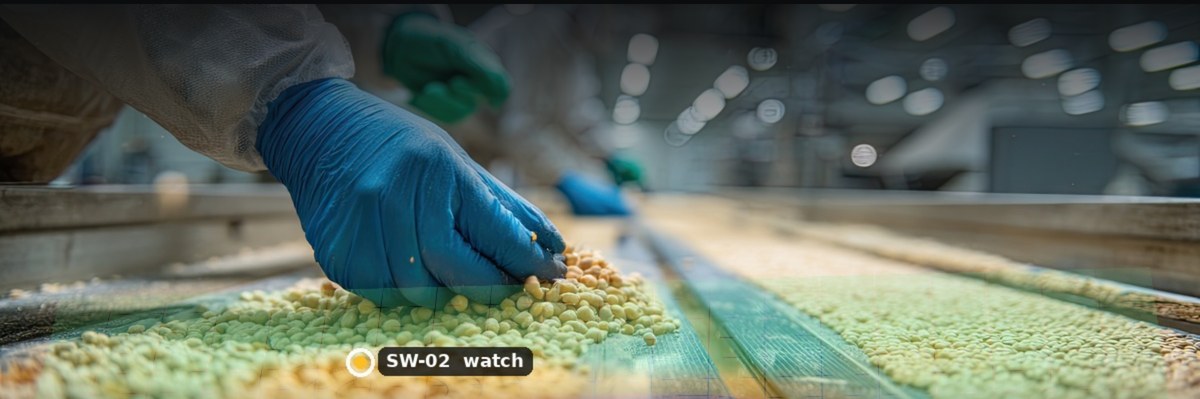
"Hyperspectral imaging" sounds like it should be able to see bacteria. It cannot, and it is worth being precise about why, because the honest answer is what makes the tool useful rather than a gimmick.
Two wavebands, two different jobs
OnXR's Food Production module uses two distinct optical techniques over the same 3D twin, each doing a different job.
UV fluorescence, at 365 nanometres, is the hygiene waveband. Organic residue and biofilm on food contact surfaces fluoresce under UV light in a way clean stainless steel does not. That fluorescence is what carries the hygiene signal.
Near infrared and short wave infrared reflectance is the moisture waveband. It picks up standing water, damp patches and differences in surface composition, the conditions that let biofilm establish in the first place, on drains, floor channels and equipment frames.
Together they build a picture of where the physical conditions for contamination are present. Both are mapped onto the exact surface in the 3D twin they came from, so a hygiene team is looking at "this drain, this bench" rather than a generic warning.
What it cannot do, stated plainly
A bacteria camera. There is no reliable optical signature that names an organism, and we do not claim one.
Replace the laboratory test. Culture stays the confirmatory result and the legal record, every time.
Work unchanged on a new plant. Every line is recalibrated and re-proven against that plant's own swabs.
From optical signal to a state on the twin
Every mapped surface in the twin carries one of three states. Clean, the surface reads clear. Watch, moisture or residue is starting to build. Act, the reading is elevated, typically earlier than the next scheduled swab round would have caught it. Those states update continuously, not once a shift, which is the entire point.
None of that is a substitute for knowing what organism, if any, is actually present. It is a prioritisation tool. It tells a hygiene team where a swab is most likely to be worth taking, and when.
Why we lead with the limits: a hygiene team that trusts a tool because it was told the truth about what it can and cannot do will use it correctly. A tool oversold as a bacteria detector gets treated as one, and that is a genuine food safety risk we are not willing to create.
None of this is trusted on day one. How a plant proves the risk map actually holds up against its own swabs, before it is relied on operationally, is the subject of the next post. Read: Prove it, then run it.
See it on your own lines
We are taking on a small number of food manufacturers as foundation partners. The pilot is free when you come onto the OnXR platform, and your lines help prove and calibrate the system.
Talk to us about a foundation pilot